

Burnout Dynamics: Simulating the Burnout Phenomenon
Description
The Problem
Workplace burnout remains a significant challenge for both researchers and organizations. It’s a complex issue that demands a more comprehensive understanding. The goal was to use System Dynamics simulations to better understand burnout and its underlying causes1.
The Challenge
Current approaches to burnout often lack a comprehensive, dynamic, and personalized view of how key factors interact. Burnout stems from a complex system of feedback loops between individual mental models, personal behaviors, and external social influences. Understanding these interactions can help organizations and employees identify burnout risks earlier and intervene more effectively.
The Approach
A causal loop diagram (CLD)1 was developed based on expert insights. Existing literature was also considered. This diagram maps out the intricate feedback loops involved in burnout. A new method was introduced to gather personal retrospective scenario data, adding a personalized dimension to the model. This data, combined with the CLD, was then translated into a quantitative System Dynamics (SD) model1.
Results
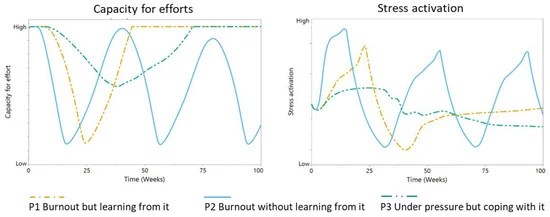
Simulations were run to show how three different personas experienced and recovered from burnout. These simulations highlighted the underlying dynamics and provided a proof-of-concept tool for predicting and managing burnout more effectively1.
Thoughts
This project represents a step toward a more dynamic and personalized approach to understanding burnout. The model offers valuable insights into early prevention and management. It does this by simulating real-life scenarios. This gives organizations a more systematic way to address burnout.
Role(s)
• Refined and enhanced the existing model.
• Edited and iterated the accompanying research paper.
Cliënt:
TNO
Project duration:
3 months
Links / papers:

“A system dynamics model of burnout integrating existing theoretical models, information from experts and literature, and personal burnout experiences. Colors indicate four main identified processes—regulating demands (blue), regulating effort (green), impacts on body and mind (red), and burnout symptoms (purple).” 1 “The response from one of the participants (digitalized with Microsoft PowerPoint). The top section shows the graphs of the seven perceived variables (amount of demands, effort, perceived efficacy, appropriateness of resources, engagement, need for recovery, stress responses) sketched by the participants. The bottom section shows the three timelines (from-top-to-bottom: interventions, developments in the work environment, developments in private life). The actual responses included notes on the developments.” 1 “Example of a simplified system dynamics (SD) model of burnout to illustrate several key elements of a SD model. Stocks accumulate over time and are indicated by rectangles. Flows indicate the rate of change of a stock and are depicted as black arrows. Variables are connected with blue arrows indicating causal links, where a plus indicates that an increase (decrease) in the variable at the tail of the arrow constitutes an increase (decrease) in the variable at the head of the arrow, all things else being equal; whereas a minus indicates that an increase (decrease) in the variable at the tail constitutes a decrease (increase) in the variable at the head, all things else being equal. Delays (//) indicate that the increase occurs after or over multiple time periods. Feedback loops are indicated as black circular arrows. A feedback loop can be reinforcing (+) or balancing (−).” 1 “Model behavior patterns for “capacity for effort” and “stress activation”, parameterized for the simulations of personas (P): P1 “burnout but learning from it” (orange dotted line), P2 “burnout without learning from it” (blue line), and P3 “under pressure but coping with it” (green dotted line).” 1


Want more info on the burnout dynamics project?
Please get in touch.